
Over the past two years, AI has become impossible to ignore. Articles, webinars, and new software features seem to be everywhere. For industrial SMEs, the pressure to integrate AI into business processes is very real. Yet the Gartner Hype Cycle 2025 tells a different story from the one we are used to hearing: Generative AI has already moved beyond the Peak of Inflated Expectations and entered the so-called Trough of Disillusionment, the stage where enthusiasm collides with the reality of real-world implementation. This moment may not be what you think, and that is exactly why it is worth taking a closer look.
Where Are We Really in the AI Cycle?
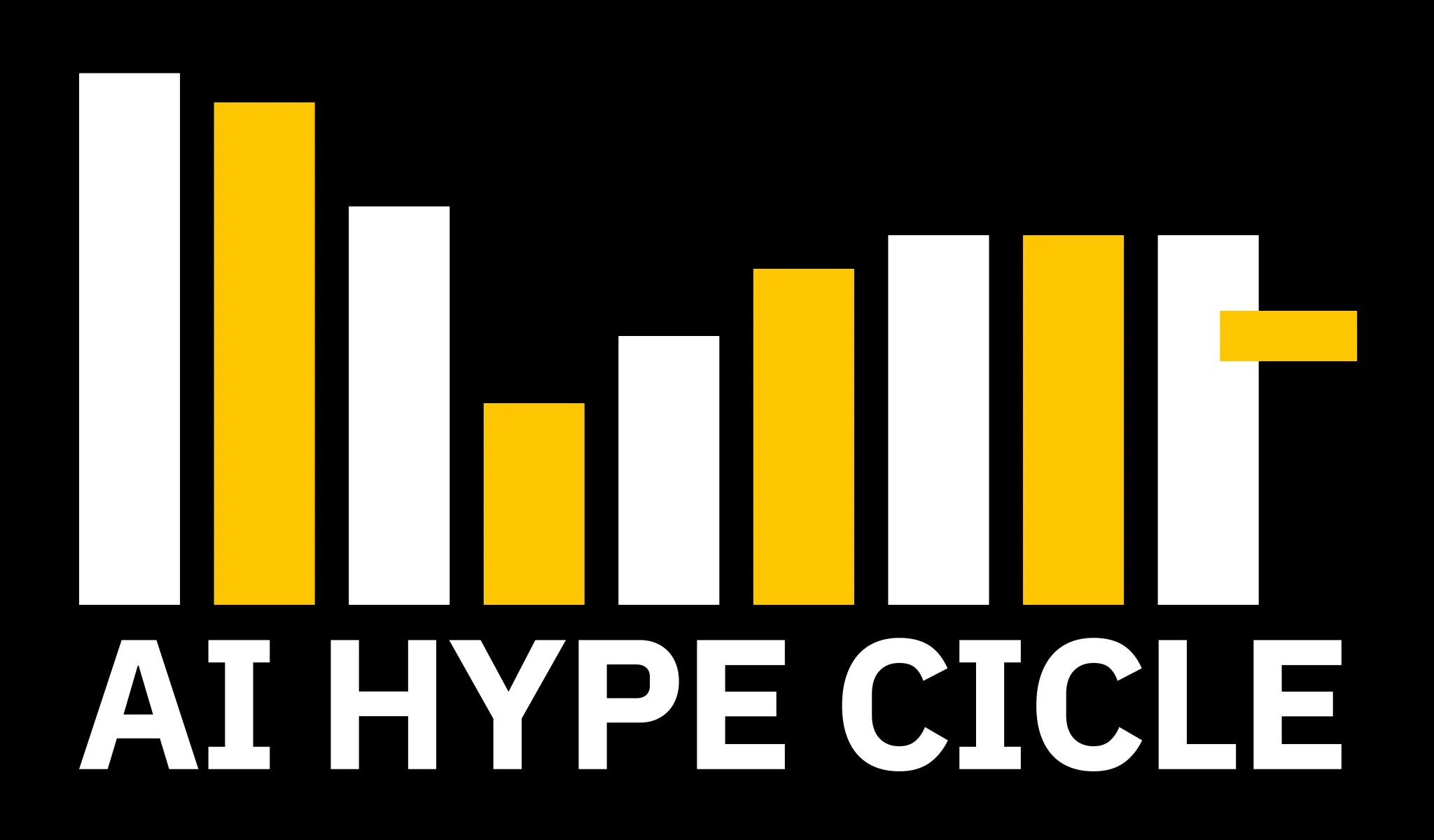
The Gartner Hype Cycle describes how technologies are perceived over time, from their launch to their stabilization in real-world use, through five stages.
It all begins with the Technology Trigger, the moment when a technology emerges and starts generating interest. This is followed by the Peak of Inflated Expectations, the peak of enthusiasm, characterized by high expectations and still-limited use cases. Then comes the Trough of Disillusionment, the phase in which the initial excitement collides with the real complexity of implementation, and many projects are abandoned or scaled back. From there, the technology moves up the Slope of Enlightenment, as use cases that truly work begin to emerge, eventually reaching the Plateau of Productivity, the point at which the technology becomes a mature tool integrated into business processes.
Every technology follows a similar curve, although at different speeds.
According to Gartner (2025), Generative AI has moved from the Peak of Inflated Expectations to the Trough of Disillusionment. This means that high expectations are now being measured against actual results, leading to a recalibration of expectations.
Italian data confirms this interpretation. According to the Artificial Intelligence Observatory of the Politecnico di Milano (2025), only one large company out of five has achieved true AI adoption across multiple business functions. Among SMEs, the situation is even more fragmented. The Italian AI market is worth €1.8 billion and is growing by 50%, but actual adoption within operational processes remains limited.
This does not mean that AI will not play a major role in the coming years. Rather, it highlights the fact that a significant gap still exists between expectations and what is actually being implemented.

Too Much or Too Little: The Two Risks for Industrial SMEs
Industrial SMEs face two symmetrical risks, both of which can be potentially costly.
The first is to ignore the AI phenomenon entirely. Companies that remain on the sidelines risk falling behind competitors that are already automating parts of their operations. This is a tangible risk that affects efficiency, speed, and the quality of both content and analysis.
The second mistake is to chase the hype without a clear strategy. Investing in AI tools without analyzing the company context and existing processes leads to superficial implementations and wasted budget.
ISTAT data (2025) shows that 83.6% of Italian SMEs have not yet adopted AI tools. The main barriers are a lack of digital skills (55.1%) and costs perceived as too high (49.6%). These figures reflect companies that have not yet found a clear method for evaluating what to adopt and when.
The challenge lies more in the adoption approach than in the technology itself.
Those who had already gone digital had a head start
AI did not emerge overnight. Companies that were already using CRMs, marketing automation platforms, or data analytics tools have the foundations needed to integrate it effectively.
There is also one point worth being clear about: much of what is called AI today was already automation. The distinction between the two terms is often more a matter of vocabulary than substance.
The gap between large enterprises and SMEs in AI adoption is significant: 53.1% versus 15.7%, a difference of 37.4 percentage points (ISTAT, 2025). Part of this gap can be explained by existing digital maturity. Large enterprises have more structured data, more documented processes, and greater resources for experimentation. An SME that has invested over the past few years in its digital presence and data quality already holds a competitive advantage over one that is starting from scratch.
How to Take Action in Practice
You do not start by choosing a tool. You start by mapping your existing processes.
The first step is to identify a repetitive and measurable process where AI can reduce real friction: content creation, data analysis, or the management of recurring requests. The key is to use it where there is a concrete problem to solve.
Here are some questions to ask yourself to determine whether a process is truly ready for AI before making an investment:
- Is the process repeatable and already documented, or does it change unpredictably every time?
- Are the data that the AI would need to work with accessible and available in a usable format?
- Can a concrete outcome be measured, such as time saved or errors reduced, before and after implementation?
- Is there someone within the company who can manage the tool, or is the organization completely dependent on the vendor?
If the answer to these questions is uncertain, it is probably not the right time to invest in that specific process. It is better to choose a simpler use case where the answers are clearer.
From there, start small, measure the results, and scale what works. This approach is consistent with the data: according to McKinsey (2025), 66% of companies using Generative AI in marketing and sales report revenue growth. Results come when AI is integrated into existing workflows.
The B2B Observatory (Marketing Arena / Ca’ Foscari, 2025) confirms that the highest-performing B2B companies use AI to generate content, personalize communications, and support creativity across different channels. These are all activities that build on already structured marketing processes.
For companies that do not yet have an established digital presence, the path is the same, with one additional step: first build the foundation, then add AI where it makes sense. The order cannot be reversed.

The Gartner Hype Cycle 2025 suggests that Generative AI has entered the most challenging stage of the cycle: the point at which promises are measured against real-world results. For an industrial SME, this may actually be a good time to take action. The urgency created by the hype has faded, but there is now enough evidence to understand what truly works. The right question is not, “Are you using AI?” It is, “Why are you using it, and for which process?”